

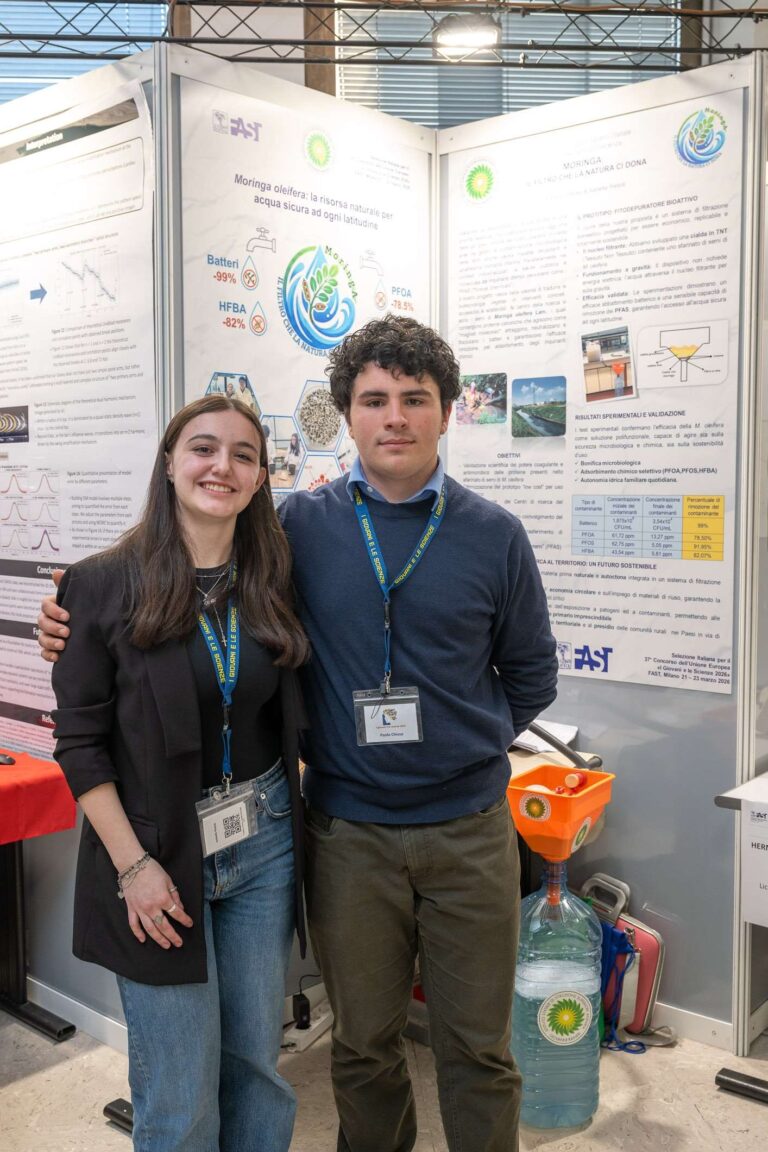
The project stems from the desire to realise a fundamental right of every individual: access to clean water. The results obtained indicate that the answer to this global challenge lies in the integration of natural resources and sustainable technology.
Precise data has emerged from the experiments carried out:
• laboratory analysis: tests on standardised samples recorded a 99% reduction in bacterial load and an 82% reduction in PFAS (PFOA, PFOS, HFBA). These results demonstrate the effectiveness of Moringa oleifera not only as a coagulant, but also as a bio-adsorbent for complex chemical pollutants;
• field trial: the prototype, assembled using reused components, demonstrated a bacterial load reduction capacity comparable to that of the laboratory tests, proving suitable for meeting the daily needs of a small household. In addition to its proven technical efficiency, our proposal meets criteria of sustainability, replicability and social impact, making it a practical solution for the local area.
• Sustainability: the project is cost-effective as the cost of the filter material is low or nonexistent and the system requires no electricity, operating solely by gravity. The use of recycled materials eliminates the need for costly investments.
• Scalability: the kit is designed to be built using common components; its simple operation requires no special skills, allowing for rapid deployment in rural centresor outlying settlements.
• Social Impact: ensuring access to purified water reduces exposure to bacteria and contaminants responsible for serious diseases. The system thus enables the
population to manage a vital resource such as water independently.
Documentation
Contact WaterTank
Manager for Stockholm Junior Water Prize

Alia Baidoun
Authors
National organizer
FAST Federation of scientific and technical associationsSponsors
FOISTFondazione Cariplo
Fondazione Salvetti
Ocmi Group
Xylem
Aica
British institutes Seregno
Cielo stellato Silvio Lutteri
Corepla
Erica
ETAss
Museo nazionale della scienza e della tecnologia Leonardo da Vinci
Unichim